A missing tooth can affect far more than a photograph. It may change the way you chew, make you cover your mouth when you laugh, or leave you worrying that nearby teeth will shift. This dental implant review looks at what implants can realistically achieve, how the treatment works, and the questions worth asking before you commit to a plan.
For many adults, a dental implant is the closest available replacement to a natural tooth. It is designed to look natural, feel stable, and support everyday functions such as eating and speaking. Still, it is a surgical treatment with a healing period, and the best choice depends on your oral health, goals, timeline, and budget.
What Is a Dental Implant?
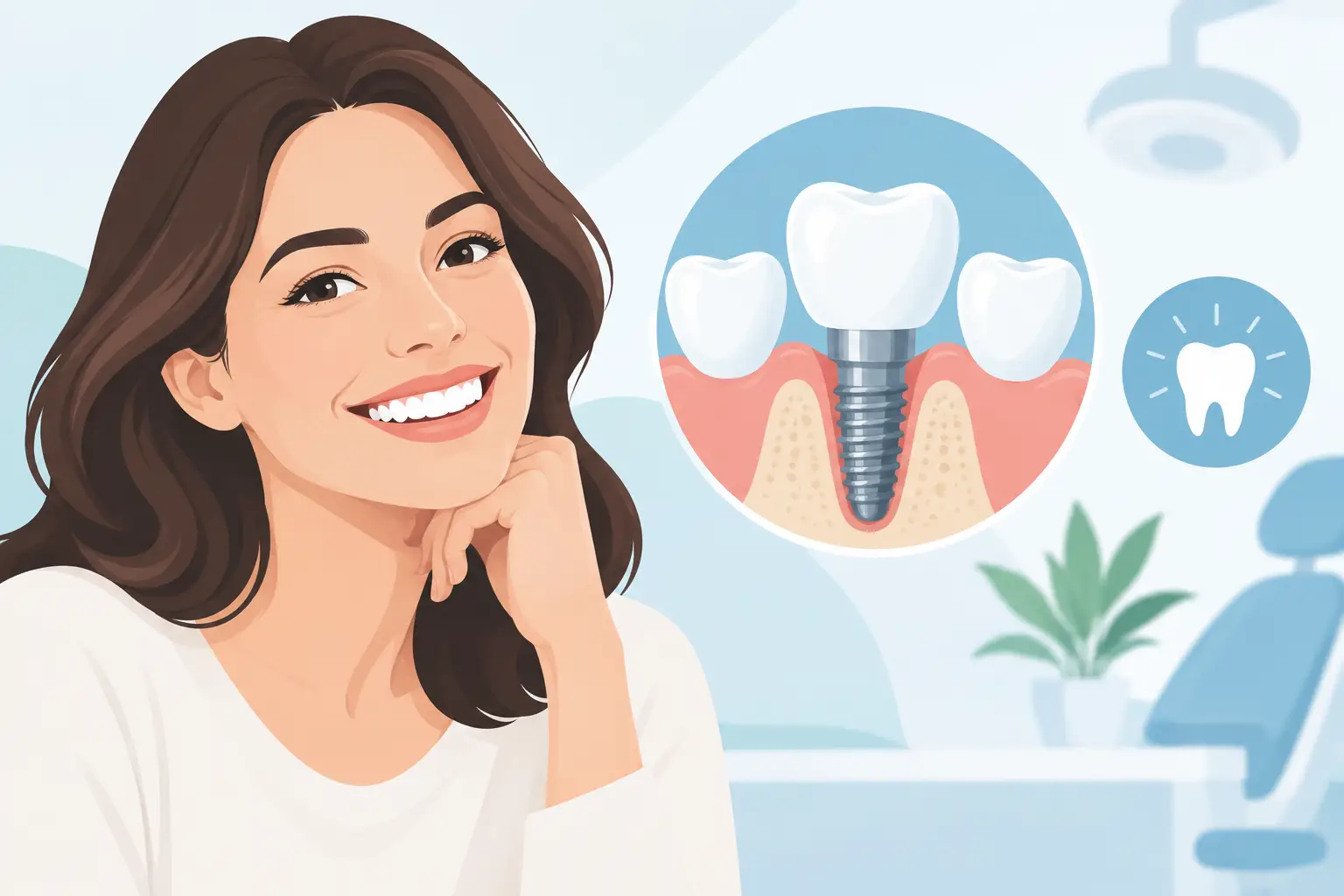
A dental implant is a small post, usually made from titanium, that is placed into the jawbone to replace a missing tooth root. Once it has healed and bonded with the bone, it can support a custom crown. The visible crown is shaped and shaded to blend with your surrounding teeth.
For a single missing tooth, the finished restoration has three main parts: the implant post below the gumline, a connector called an abutment, and the crown above the gumline. Implants can also support bridges or full-arch tooth replacement when several teeth are missing.
Unlike a removable denture, an implant does not need to be taken out at night. Unlike a traditional bridge, it often allows the neighboring teeth to remain untouched. Those differences are a major reason patients consider implants when they want a long-term, fixed solution.
Dental Implant Review: The Benefits and Trade-Offs
The strongest advantage of an implant is stability. Because it is anchored in the jaw, it can make biting and chewing feel more natural than a removable option. A carefully planned implant crown can also restore the appearance of a complete, balanced smile without looking noticeably different from adjacent teeth.
Implants may help preserve the jawbone after tooth loss. When a tooth root is missing, the bone in that area can gradually shrink because it no longer receives normal chewing stimulation. An implant can help maintain that stimulation, although the amount of existing bone and the timing of treatment both matter.
There are trade-offs to consider. Implant treatment takes time. After placement, the implant needs a period to integrate with the bone before the final crown is fitted. Some patients need bone grafting, gum treatment, or extraction-site healing first, which can extend the schedule. A bridge or removable denture may be completed faster in certain situations.
Cost is another practical consideration. Implants often require a larger initial investment than other replacement options, particularly if preparatory treatment is needed. Their durability and the potential to protect neighboring teeth can make them an excellent value over time, but that value is personal. A clear, written treatment plan should explain every stage and any anticipated additional procedures.
Who Is a Good Candidate?
Many healthy adults can be candidates for dental implants, including people who have lived with a missing tooth for years. Good candidacy is not based on age alone. It depends more on the health of your gums, the amount and quality of jawbone, your bite, medical history, and ability to maintain daily oral hygiene.
Healthy gums are essential. Untreated gum disease can compromise the tissues and bone around an implant, so a dentist may recommend periodontal care before moving forward. If bone volume is limited, a graft may create a more stable foundation. This is not automatically a reason to rule out implants. It simply means the treatment needs more careful planning.
Smoking, uncontrolled diabetes, teeth grinding, and certain medications can affect healing or long-term success. These factors do not always prevent treatment, but they should be discussed openly. The right clinician will explain your individual risks rather than promising the same outcome to every patient.
A comprehensive consultation usually includes a clinical examination, digital X-rays or 3D imaging, and a review of your medical and dental history. This planning stage matters because implant placement should account for bone anatomy, bite forces, gum appearance, and the final position of the crown – not only the empty space.
What the Treatment Process Feels Like
The thought of implant surgery can feel intimidating, especially for patients with dental anxiety. In a properly planned procedure, patient comfort is central. Local anesthesia is used to numb the area, so you should not feel pain during placement. You may notice pressure or vibration, but your dental team should explain each step and check that you are comfortable.
After the procedure, mild swelling, tenderness, or bruising can occur for several days. Most patients manage this with the aftercare instructions provided by their dentist, prescribed or over-the-counter medication when appropriate, soft foods, and a short period of rest. Recovery experiences vary based on the complexity of the procedure and whether grafting or extractions were completed at the same visit.
The healing phase gives the implant time to integrate with the jawbone. In some cases, a temporary tooth can be used while healing takes place. Once the implant is ready, impressions or digital scans guide the creation of a custom crown. The final appointment is not just about attaching a tooth. Your dentist will check the bite, fit, shade, shape, and comfort so the result functions naturally.
How Long Do Dental Implants Last?
With good care, the implant post can last for many years and often much longer. The crown may eventually need replacement because it is exposed to daily chewing forces, just like a natural tooth can wear or fracture over time. Long-term success depends on skilled planning, precise placement, healthy gums, and consistent maintenance.
Caring for an implant is straightforward, but it is not maintenance-free. Brush twice daily, clean between teeth with the tools recommended for your restoration, and attend regular dental checkups and hygiene visits. Professional monitoring helps identify inflammation, bite changes, or crown wear early.
Patients who grind their teeth may benefit from a custom night guard to protect the implant crown and natural teeth. This is a small preventive step that can reduce excessive forces while you sleep.
Questions to Ask Before Choosing an Implant
A good implant consultation should leave you informed, not pressured. Ask which specialist will plan and place the implant, what imaging will be used, whether your gums and bone need treatment first, and what type of crown is recommended. You should also ask about your expected timeline, the temporary tooth options, the total cost, and how follow-up care will be handled.
It is also reasonable to ask what happens if an implant does not heal as expected. While implants have a high success rate, no medical or dental treatment can be guaranteed. A trusted clinic will discuss both the benefits and the possible complications with clarity.
At Bright Smile Medical Center, implant planning is approached as part of your complete oral health and smile goals. That means considering how the replacement tooth will look, feel, function, and fit with any future cosmetic or restorative treatment you may be considering.
A dental implant is not simply a way to fill a space. For the right patient, it can be a carefully planned investment in comfortable eating, clearer confidence, and a smile that feels like your own again. A personal consultation is the best next step when you want answers tailored to your mouth, health, and priorities.
Need Help?
Schedule your initial consultation today and start your journey towards a pain-free, healthier smile. Contact us now!
(function() {
// Global page view and session tracking for UAEL Modal Popup feature
try {
// Session tracking: increment if this is a new session
// Check if any popup on this page uses current page tracking
var hasCurrentPageTracking = false;
var currentPagePopups = [];
// Check all modal popups on this page for current page tracking
if (typeof jQuery !== 'undefined') {
jQuery('.uael-modal-parent-wrapper').each(function() {
var scope = jQuery(this).data('page-views-scope');
var enabled = jQuery(this).data('page-views-enabled');
var popupId = jQuery(this).attr('id').replace('-overlay', '');
if (enabled === 'yes' && scope === 'current') {
hasCurrentPageTracking = true;
currentPagePopups.push(popupId);
}
});
}
// Global tracking: ALWAYS increment if ANY popup on the site uses global tracking
// Current page tracking: increment per-page counters
if (hasCurrentPageTracking && currentPagePopups.length > 0) {
var currentUrl = window.location.href;
var urlKey = 'uael_page_views_' + btoa(currentUrl).replace(/[^a-zA-Z0-9]/g, '').substring(0, 50);
var currentPageViews = parseInt(localStorage.getItem(urlKey) || '0');
currentPageViews++;
localStorage.setItem(urlKey, currentPageViews.toString());
// Store URL mapping for each popup
for (var i = 0; i < currentPagePopups.length; i++) {
var popupUrlKey = 'uael_popup_' + currentPagePopups[i] + '_url_key';
localStorage.setItem(popupUrlKey, urlKey);
}
}
} catch (e) {
// Silently fail if localStorage is not available
}
})();
var uael_particles_script = {"uael_particles_url":"https://brightsmileshj.com/wp-content/plugins/ultimate-elementor/assets/min-js/uael-particles.min.js","particles_url":"https://brightsmileshj.com/wp-content/plugins/ultimate-elementor/assets/lib/particles/particles.min.js","snowflakes_image":"https://brightsmileshj.com/wp-content/plugins/ultimate-elementor/assets/img/snowflake.svg","gift":"https://brightsmileshj.com/wp-content/plugins/ultimate-elementor/assets/img/gift.png","tree":"https://brightsmileshj.com/wp-content/plugins/ultimate-elementor/assets/img/tree.png","skull":"https://brightsmileshj.com/wp-content/plugins/ultimate-elementor/assets/img/skull.png","ghost":"https://brightsmileshj.com/wp-content/plugins/ultimate-elementor/assets/img/ghost.png","moon":"https://brightsmileshj.com/wp-content/plugins/ultimate-elementor/assets/img/moon.png","bat":"https://brightsmileshj.com/wp-content/plugins/ultimate-elementor/assets/img/bat.png","pumpkin":"https://brightsmileshj.com/wp-content/plugins/ultimate-elementor/assets/img/pumpkin.png"};
var EAELImageMaskingConfig = {"svg_dir_url":"https://brightsmileshj.com/wp-content/plugins/essential-addons-for-elementor-lite/assets/front-end/img/image-masking/svg-shapes/"};
//# sourceURL=elementor-frontend-js-extra
var elementorFrontendConfig = {"environmentMode":{"edit":false,"wpPreview":false,"isScriptDebug":false},"i18n":{"shareOnFacebook":"Share on Facebook","shareOnTwitter":"Share on Twitter","pinIt":"Pin it","download":"Download","downloadImage":"Download image","fullscreen":"Fullscreen","zoom":"Zoom","share":"Share","playVideo":"Play Video","previous":"Previous","next":"Next","close":"Close","a11yCarouselPrevSlideMessage":"Previous slide","a11yCarouselNextSlideMessage":"Next slide","a11yCarouselFirstSlideMessage":"This is the first slide","a11yCarouselLastSlideMessage":"This is the last slide","a11yCarouselPaginationBulletMessage":"Go to slide"},"is_rtl":false,"breakpoints":{"xs":0,"sm":480,"md":768,"lg":1025,"xl":1440,"xxl":1600},"responsive":{"breakpoints":{"mobile":{"label":"Mobile Portrait","value":767,"default_value":767,"direction":"max","is_enabled":true},"mobile_extra":{"label":"Mobile Landscape","value":880,"default_value":880,"direction":"max","is_enabled":false},"tablet":{"label":"Tablet Portrait","value":1024,"default_value":1024,"direction":"max","is_enabled":true},"tablet_extra":{"label":"Tablet Landscape","value":1200,"default_value":1200,"direction":"max","is_enabled":false},"laptop":{"label":"Laptop","value":1366,"default_value":1366,"direction":"max","is_enabled":false},"widescreen":{"label":"Widescreen","value":2400,"default_value":2400,"direction":"min","is_enabled":false}},"hasCustomBreakpoints":false},"version":"4.1.1","is_static":false,"experimentalFeatures":{"e_font_icon_svg":true,"additional_custom_breakpoints":true,"container":true,"theme_builder_v2":true,"hello-theme-header-footer":true,"nested-elements":true,"global_classes_should_enforce_capabilities":true,"e_variables":true,"e_opt_in_v4_page":true,"e_components":true,"e_interactions":true,"e_widget_creation":true,"import-export-customization":true,"e_pro_variables":true},"urls":{"assets":"https:\/\/brightsmileshj.com\/wp-content\/plugins\/elementor\/assets\/","ajaxurl":"https:\/\/brightsmileshj.com\/wp-admin\/admin-ajax.php","uploadUrl":"https:\/\/brightsmileshj.com\/wp-content\/uploads"},"nonces":{"floatingButtonsClickTracking":"dbf2b274ef","atomicFormsSendForm":"ab1fc7c830"},"swiperClass":"swiper","settings":{"page":[],"editorPreferences":[]},"kit":{"active_breakpoints":["viewport_mobile","viewport_tablet"],"global_image_lightbox":"yes","lightbox_enable_counter":"yes","lightbox_enable_fullscreen":"yes","lightbox_enable_zoom":"yes","lightbox_enable_share":"yes","lightbox_title_src":"title","lightbox_description_src":"description"},"post":{"id":2439,"title":"Dental%20Implant%20Review%20for%20a%20Confident%20Smile%20-%20Bright%20Smile%20Medical%20Center%20%7C%20Dental%20Clinic%20In%20Sharjah","excerpt":"A dental implant review explains benefits, candidacy, comfort, costs, and care so you can choose a secure, natural-looking replacement tooth with clarity today.","featuredImage":"https:\/\/brightsmileshj.com\/wp-content\/uploads\/2026\/09\/dental-implant-review-for-a-confident-smile-featured-1024x683.webp"}};
//# sourceURL=elementor-frontend-js-before