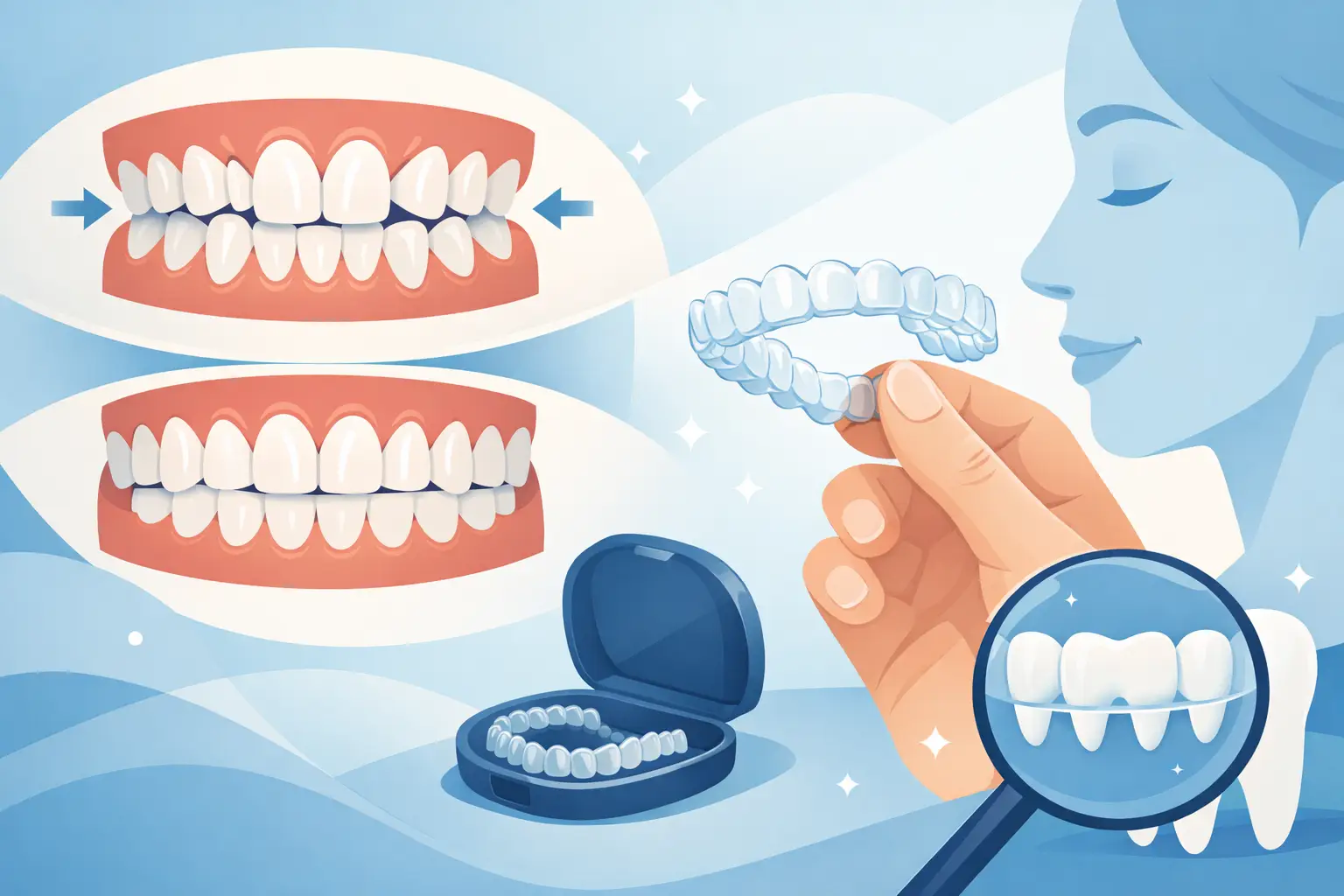
If your teeth overlap, twist, or seem to compete for space when you smile, you are probably asking a very practical question: does Invisalign work for crowding? In many cases, yes. Invisalign can be very effective for mild to moderate crowding, and in some more advanced cases as well, but the right answer depends on how crowded the teeth are, where the crowding is located, and whether your bite also needs correction.
That distinction matters because crowding is not just a cosmetic issue. When teeth sit too close together, they can be harder to clean properly, which may increase the risk of plaque buildup, gum inflammation, and uneven wear. For many adults and teens, treatment is about looking better and making daily oral care easier.
Does Invisalign work for crowding in real cases?
Crowding happens when there is not enough room in the jaw for all the teeth to align properly. Some people have one or two teeth that slightly overlap. Others have lower front teeth that are heavily rotated or upper teeth that push forward because the arch is too narrow. Invisalign is designed to move teeth gradually through a series of custom clear aligners, and that controlled movement can create better spacing and alignment over time.
For mild crowding, Invisalign is often a very strong option. Small rotations, slight overlap, and front teeth that need gentle repositioning usually respond well to aligners. Moderate crowding can also be treated successfully, especially when the treatment plan includes attachments, enamel reshaping between certain teeth, or carefully staged movements.
More severe crowding is where the answer becomes more nuanced. Invisalign may still work, but not always as a standalone solution. Some patients need tooth reshaping to create space. Others may need extractions, expansion, or a different orthodontic approach if the bite is complex. The aligners are only as effective as the diagnosis and treatment planning behind them, which is why a proper orthodontic assessment is essential.
What makes Invisalign effective for crowded teeth?
Clear aligners work by applying light, consistent pressure to specific teeth. Each set is slightly different from the last, guiding your teeth toward their planned positions. When used as prescribed, typically 20 to 22 hours a day, they can produce precise movement in a gradual and comfortable way.
One reason Invisalign appeals to adults and working professionals is that it is discreet. You can straighten your teeth without the look of metal braces, and the aligners are removable for meals, brushing, and important social or professional events. That convenience can make treatment feel far easier to manage in everyday life.
For crowding, Invisalign can help by widening the arch slightly, moving teeth into better alignment, and reducing overlapping. In many cases, small amounts of enamel are polished between selected teeth to create the room needed for movement. This is called interproximal reduction, and when done conservatively, it can be a very useful part of treatment.
Attachments also play a major role. These are small tooth-colored shapes bonded to certain teeth so the aligners can grip them more effectively. They help with movements that are more difficult, such as rotating a tooth or shifting it in a more controlled direction. Patients sometimes worry when they hear about attachments, but they are common, discreet, and often the reason a crowded case responds well.
When Invisalign may not be enough
The honest answer to does Invisalign work for crowding is that it depends on severity. If the teeth are extremely crowded, if several teeth are severely rotated, or if the upper and lower jaws do not fit together properly, treatment may need more than aligners alone.
For example, a patient with major crowding and a deep bite may still be a candidate for Invisalign, but the plan may be longer and more involved. Another patient with significant crowding caused by jaw size discrepancy may be better suited to braces or a combined approach. In younger patients whose jaws are still developing, timing can also influence the best choice.
This is where specialist evaluation becomes valuable. Two smiles may look similarly crowded in a photo, yet require very different treatment plans. One may be solved with aligners in under a year. The other may need tooth removal, bite correction, or a more comprehensive orthodontic plan.
How treatment is planned for crowded teeth
A good Invisalign plan starts with records, not guesses. Your dentist or orthodontic provider will examine your teeth, bite, gums, and jaw relationship, often using digital scans and X-rays. This helps determine whether the crowding is limited to tooth position or part of a bigger structural issue.
From there, a custom plan maps how each tooth should move. This matters because crowding is not fixed by simply pushing the front teeth outward. Teeth need to be moved in a way that protects the bite, keeps the roots stable, and supports long-term health. A polished smile result should also be a healthy one.
In some cases, the provider will recommend creating space through enamel reshaping between teeth. In other cases, attachments are placed to improve control. If the crowding is more advanced, treatment may involve refinements, which means additional aligners are made after the first series to perfect the result. This is normal and often part of achieving a better finish.
How long does Invisalign take for crowding?
Treatment time varies. Mild crowding may improve in as little as 6 to 9 months, while moderate cases often take 12 to 18 months. More complex crowding can take longer, especially if bite correction is also involved.
Compliance is a major factor. Invisalign only works well when it is worn consistently. If aligners are left out for long periods, teeth do not track as planned, and treatment can slow down or lose accuracy. Patients who wear them faithfully usually see better progress and fewer delays.
It is also worth knowing that teeth may look better before treatment is truly complete. The visible crowding might improve early, but the final stages are often focused on refining the bite and stabilizing the result. That part is just as important as the cosmetic change.
Invisalign vs braces for crowding
For many adults, the question is not only does Invisalign work for crowding, but whether it works as well as braces. The answer is that both can be effective, but they have different strengths.
Invisalign is often preferred for appearance, comfort, and convenience. It is easier to remove for eating and oral hygiene, and there are no brackets or wires rubbing against the cheeks. For mild to moderate crowding, it can deliver excellent results.
Braces may offer more control in certain severe cases, especially when teeth are significantly rotated or when complex bite mechanics are needed. They do not depend on patient compliance in the same way because they stay on the teeth full time. That can be an advantage for younger patients or anyone who may struggle to wear aligners as directed.
The right choice depends on your clinical needs and your lifestyle. A treatment that fits your routine is more likely to succeed.
What patients should expect during Invisalign treatment
Most people adjust to aligners within a few days. Each new set may create mild pressure, which is a sign the teeth are moving, but treatment is generally considered more comfortable than traditional braces. You may notice a temporary change in speech at first, though this usually improves quickly.
Oral hygiene is often easier with Invisalign because you can remove the trays to brush and floss. That said, the aligners must be cleaned properly, and you should avoid putting them back in after meals without brushing whenever possible. Good habits protect both your teeth and the clarity of the trays.
Regular check-ins matter. Even though Invisalign feels simple day to day, the treatment still needs professional monitoring to make sure teeth are moving correctly and the plan stays on track.
At Bright Smile Medical Center, this kind of careful planning is what turns a cosmetic wish into a result that feels natural, comfortable, and worth the effort.
A good candidate is not just about crowding
If you are considering Invisalign, the best question is not only whether it can straighten crowded teeth. It is whether it can do so safely, predictably, and in a way that supports your bite and long-term oral health. That is why candidacy is based on more than appearance alone.
Healthy gums, strong bone support, and realistic expectations all matter. If you have untreated cavities, gum disease, or jaw issues, those may need attention first. The most attractive result is one that is built on a healthy foundation.
For many patients, Invisalign is an excellent solution for crowding. It is discreet, effective, and well suited to people who want visible improvement without the look of braces. But the best outcomes come from personalized planning, not one-size-fits-all promises.
If your teeth feel crowded and you want a clearer idea of what is possible, the next step is simple: get your smile assessed properly. Seeing what can be improved, what may take longer, and what approach fits your life is often the moment uncertainty turns into a confident plan.
Need Help?
Schedule your initial consultation today and start your journey towards a pain-free, healthier smile. Contact us now!
(function() {
// Global page view and session tracking for UAEL Modal Popup feature
try {
// Session tracking: increment if this is a new session
// Check if any popup on this page uses current page tracking
var hasCurrentPageTracking = false;
var currentPagePopups = [];
// Check all modal popups on this page for current page tracking
if (typeof jQuery !== 'undefined') {
jQuery('.uael-modal-parent-wrapper').each(function() {
var scope = jQuery(this).data('page-views-scope');
var enabled = jQuery(this).data('page-views-enabled');
var popupId = jQuery(this).attr('id').replace('-overlay', '');
if (enabled === 'yes' && scope === 'current') {
hasCurrentPageTracking = true;
currentPagePopups.push(popupId);
}
});
}
// Global tracking: ALWAYS increment if ANY popup on the site uses global tracking
// Current page tracking: increment per-page counters
if (hasCurrentPageTracking && currentPagePopups.length > 0) {
var currentUrl = window.location.href;
var urlKey = 'uael_page_views_' + btoa(currentUrl).replace(/[^a-zA-Z0-9]/g, '').substring(0, 50);
var currentPageViews = parseInt(localStorage.getItem(urlKey) || '0');
currentPageViews++;
localStorage.setItem(urlKey, currentPageViews.toString());
// Store URL mapping for each popup
for (var i = 0; i < currentPagePopups.length; i++) {
var popupUrlKey = 'uael_popup_' + currentPagePopups[i] + '_url_key';
localStorage.setItem(popupUrlKey, urlKey);
}
}
} catch (e) {
// Silently fail if localStorage is not available
}
})();
var uael_particles_script = {"uael_particles_url":"https://brightsmileshj.com/wp-content/plugins/ultimate-elementor/assets/min-js/uael-particles.min.js","particles_url":"https://brightsmileshj.com/wp-content/plugins/ultimate-elementor/assets/lib/particles/particles.min.js","snowflakes_image":"https://brightsmileshj.com/wp-content/plugins/ultimate-elementor/assets/img/snowflake.svg","gift":"https://brightsmileshj.com/wp-content/plugins/ultimate-elementor/assets/img/gift.png","tree":"https://brightsmileshj.com/wp-content/plugins/ultimate-elementor/assets/img/tree.png","skull":"https://brightsmileshj.com/wp-content/plugins/ultimate-elementor/assets/img/skull.png","ghost":"https://brightsmileshj.com/wp-content/plugins/ultimate-elementor/assets/img/ghost.png","moon":"https://brightsmileshj.com/wp-content/plugins/ultimate-elementor/assets/img/moon.png","bat":"https://brightsmileshj.com/wp-content/plugins/ultimate-elementor/assets/img/bat.png","pumpkin":"https://brightsmileshj.com/wp-content/plugins/ultimate-elementor/assets/img/pumpkin.png"};
var EAELImageMaskingConfig = {"svg_dir_url":"https://brightsmileshj.com/wp-content/plugins/essential-addons-for-elementor-lite/assets/front-end/img/image-masking/svg-shapes/"};
//# sourceURL=elementor-frontend-js-extra
var elementorFrontendConfig = {"environmentMode":{"edit":false,"wpPreview":false,"isScriptDebug":false},"i18n":{"shareOnFacebook":"Share on Facebook","shareOnTwitter":"Share on Twitter","pinIt":"Pin it","download":"Download","downloadImage":"Download image","fullscreen":"Fullscreen","zoom":"Zoom","share":"Share","playVideo":"Play Video","previous":"Previous","next":"Next","close":"Close","a11yCarouselPrevSlideMessage":"Previous slide","a11yCarouselNextSlideMessage":"Next slide","a11yCarouselFirstSlideMessage":"This is the first slide","a11yCarouselLastSlideMessage":"This is the last slide","a11yCarouselPaginationBulletMessage":"Go to slide"},"is_rtl":false,"breakpoints":{"xs":0,"sm":480,"md":768,"lg":1025,"xl":1440,"xxl":1600},"responsive":{"breakpoints":{"mobile":{"label":"Mobile Portrait","value":767,"default_value":767,"direction":"max","is_enabled":true},"mobile_extra":{"label":"Mobile Landscape","value":880,"default_value":880,"direction":"max","is_enabled":false},"tablet":{"label":"Tablet Portrait","value":1024,"default_value":1024,"direction":"max","is_enabled":true},"tablet_extra":{"label":"Tablet Landscape","value":1200,"default_value":1200,"direction":"max","is_enabled":false},"laptop":{"label":"Laptop","value":1366,"default_value":1366,"direction":"max","is_enabled":false},"widescreen":{"label":"Widescreen","value":2400,"default_value":2400,"direction":"min","is_enabled":false}},"hasCustomBreakpoints":false},"version":"4.1.1","is_static":false,"experimentalFeatures":{"e_font_icon_svg":true,"additional_custom_breakpoints":true,"container":true,"theme_builder_v2":true,"hello-theme-header-footer":true,"nested-elements":true,"global_classes_should_enforce_capabilities":true,"e_variables":true,"e_opt_in_v4_page":true,"e_components":true,"e_interactions":true,"e_widget_creation":true,"import-export-customization":true,"e_pro_variables":true},"urls":{"assets":"https:\/\/brightsmileshj.com\/wp-content\/plugins\/elementor\/assets\/","ajaxurl":"https:\/\/brightsmileshj.com\/wp-admin\/admin-ajax.php","uploadUrl":"https:\/\/brightsmileshj.com\/wp-content\/uploads"},"nonces":{"floatingButtonsClickTracking":"838f20a56a","atomicFormsSendForm":"25382f78b9"},"swiperClass":"swiper","settings":{"page":[],"editorPreferences":[]},"kit":{"active_breakpoints":["viewport_mobile","viewport_tablet"],"global_image_lightbox":"yes","lightbox_enable_counter":"yes","lightbox_enable_fullscreen":"yes","lightbox_enable_zoom":"yes","lightbox_enable_share":"yes","lightbox_title_src":"title","lightbox_description_src":"description"},"post":{"id":1947,"title":"Does%20Invisalign%20Work%20for%20Crowding%3F%20-%20Bright%20Smile%20Medical%20Center%20%7C%20Dental%20Clinic%20In%20Sharjah","excerpt":"Does Invisalign work for crowding? Learn which cases respond well, what limits aligners have, and when attachments or other orthodontics may be needed.","featuredImage":"https:\/\/brightsmileshj.com\/wp-content\/uploads\/2026\/07\/does-invisalign-work-for-crowding-featured-1024x683.webp"}};
//# sourceURL=elementor-frontend-js-before